Several months ago, I was approached by Mohammad Salehi, Founder and Owner of Heray Spice, asking me to try his saffron. So often I’m approached by a variety of vendors of really great products- some better than others and some more interesting than others. Mohammad’s products are fantastic, but his story is something I appreciated even more.
(To listen to Mohammad’s full story, join our podcast on Aug. 30. You can subscribe to my new Everyday Mediterranean Newsletter on Substack to get the update.
As he explained to me, he’s from Afghanistan and never thought he would start a saffron business, but once he came to the U.S. he quickly saw a gap in the market for high quality saffron, and a way that he could sustainably and ethically source this rare, fragrant and much-loved ‘spice’ by working with a variety of farmers throughout his country. And that is pretty much the sum of parts in how Heray Spice was formed. On the daily, I see his persistence and hustle and how much passion and belief he has in his products, but most of all I see how determined he is to help those back in his home country to live with honorable work, as well as to provide those in his new country to experience pure ingredients that not only enhance one’s cooking but also one’s health.
Products
Heray Spice, although most known for their high-quality authentic saffron, also sells this amazing wild cumin that is just perfect for cooking your favorite Middle Eastern recipes. I love that it comes whole because you can roast and grind them fresh for the earthiest flavors possible in your recipes.
Harissa Spice Blend is a wonderfully aromatic blend of Afghan spices unique to Heray Spice.
Contact Information
To follow, contact, or order Heray Spice blends or individually bottled spices:
You can often find Mohammad and his Heray Spice products in and around Chicagoland where their family business is based. He is often seen at shows, conferences and farmers markets displaying and selling his products beautifully. How delightful to experience these spices in person!
This post may contain affiliate links, which means that I may receive a commission if you make a purchase using these links. As an Amazon Associate, I earn a commission from qualifying links.
Truthfully, I was hesitant to dive in because I knew it would take me to a dream world I might not ever get back to in real life. When I lived in Turkiye and traveled along the Aegean Coast, I was always trying to get to Ikaria, but could never make it.
The adventurer inside of me remembered my young self..
When I was just 19 years old, I became a solo traveler through Europe, by accident. I was visiting my family in Sicily when I got the travel bug to see more and more, so I hopped on a train to Bari and took a ferry through the Adriatic and landed on the island of Corfu.
This was way back before the internet, blogs and social media hailed the glories of solo travels, women solo travelers especially, and all the hot spots to take a selfie. Instead, I was able to peacefully take photos, meet incredibly warm local villagers who showed me their gardens and invited me for fresh home-grown watermelon. I ate the purest seafood directly from Aegean, unseasoned vegetable salads that actually taught me what cucumbers are supposed to be, and spoke to village Yaiyas about their secrets to reaching old age in such a healthy way. One told me to always peel your cucumber!
While enjoying my little cup of Greek coffee and a village breakfast high up in a mountainside home for just $12 USD per night, I wrote in my diary (not a laptop or cell phone notes) a vow to myself that I would someday make a life for myself in the Mediterranean. To live in this simplicity. In this healthy air. To have neighbors, friends and family that were just as kind, happy, quiet and hard-working as the people of Corfu.
Fast forward to now and my life looks nothing like that. I broke all the promises to myself about living in the Mediterranean. I’ve tried and feel like I failed, but I have learned to cook some pretty great things.
And I’ve learned to bring the Mediterranean lifestyle with me wherever I go, as much as I possibly can.
One way I do that is to eat as many greens as possible. To get as much sunshine as possible. To keep inspiring myself with stories, books, and recipes about the Mediterranean so that I can share that with all of you.
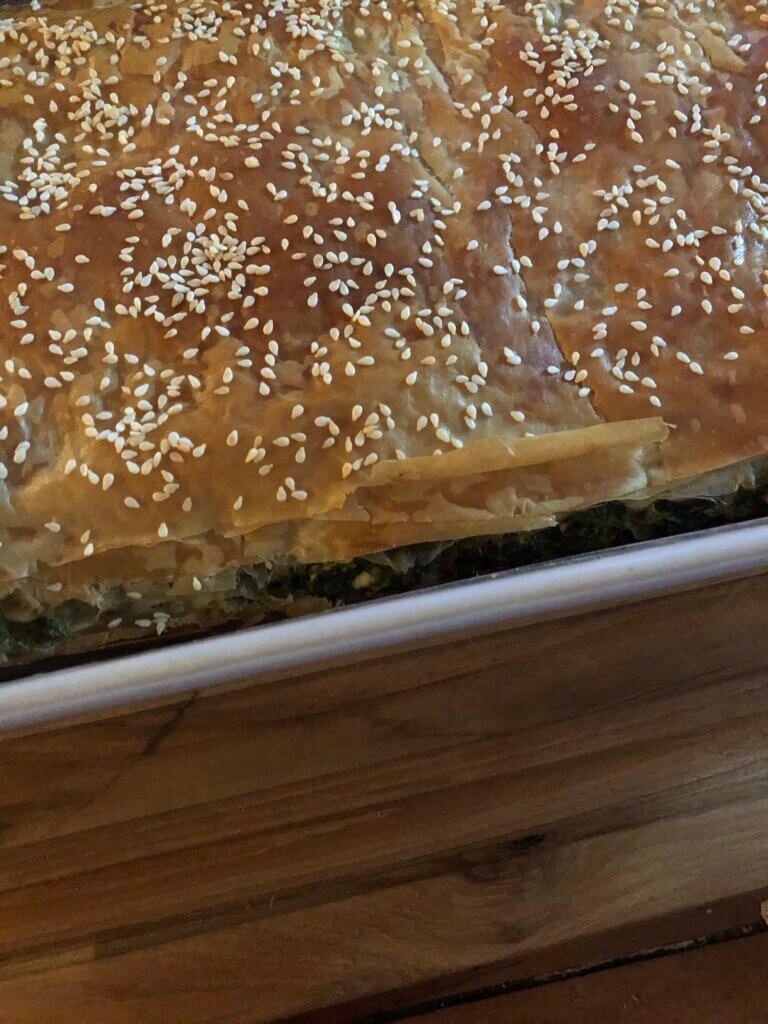
So I wanted to bring you a recipe this week that invokes both sides of the Aegean Sea, yet shared in both Greece and Turkiye. This is my specific take on it, my version, with the greens that I could find: Aegean Village Greens Pie. It’s not a sweet “pie”. Pie in this culinary cultural context is savory.
Aegean Village Greens Pie
Serves 6
I always tell people not to be intimidate by fillo dough. It’s much more forgiving than you think. I’m not including a recipe for homemade fillo dough now, because first I want you to get used to sourcing and cooking- and enjoyably eating those greens!
First, go out and look for greens- not just spinach. I promise you, you’ll find them. Also, spring onions and leeks (leave out the leeks if you can’t find them, it’s okay):
Spinach
Dandelions
Beets (you’ll use only the greens)
Swiss Chard (any variety)
Spring onions
Leeks
Next, I want you to look for fresh herbs and onions. Please try to avoid dried herbs for this recipe, except for dried thyme.
Dill
Parsley (flat leaf, if possible)
Mint
Next, I want you to find the creamiest feta cheese possible:
For me, the best one is the Macedonian style feta cheese (more readily found in Canada). You can use other types of feta, but in my opinion most are way too dry except for perhaps the Valbreso brand French Feta Cheese, which is more easily found in the U.S. I think I may have even seen it at Costco…
*I used Sotidakis Goat Feta Chevre (from Costco) once and it was good, but not moist enough for this recipe, in my opinion.*
If you can’t find either, then so be it – just use what you can find.
Lastly, find a good fillo dough (in the freezer section of most Mediterranean and Middle Eastern markets, as well as most grocery stores). My go-tos are Fillo Factory Organic or Krinos, but you can really use any that work for savory pies. Just make sure they’re not shaped like a triangle or molded into cups- that’s for other types of fillo dishes. You’re going to bring the fillo home and put it in the refrigerator. But not for too many days (3-4 days tops), otherwise it will start to get moldy.
You’ll probably have the rest of the ingredients on hand at home, but just in case:
A really great quality olive oil (that should be part of your cooking at all times, anyway, not just for this recipe). Might I be a little bit proud and mention our beloved Oil of Anatolia from Turkiye?
Farm fresh eggs
Black seed or sesame seeds (whichever you wish to top the spinach pies with)
Milk, for mixing with oil or butter, to wash the fillo
Silicone pastry brush
Rectangular deep pan (i.e. lasagna pan is good but a bit large). Round pans are okay but you’ll have to fanagle the fillo, which can be annoying
Measurements of Ingredients:
Approximately 3 cups cooked greens mixture (see below)
Fresh or dried garlic or garlic powder (optional)
All fresh herbs, washed, dried and roughly chopped
1-2 eggs (1 large or 2 small)
3/4 cup Feta cheese
1 teaspoon crushed black or white pepper
dry thyme or oregano (1-2 teaspoons)
1/2 teaspoon salt (optional)
1 packet fillo (also spelled “phyllo”) dough, thawed in the refrigerator
Directions for Assembling and Baking:
HOW TO COOK THE GREENS
Wash and dry all the greens and onions. If using, chop the stems of any Swiss chard finely. If using spring onions or leeks, use the white parts for this recipe by chopping them finely.
In a small saute pan or pot, gently heat the olive oil. Add the onions then the stems or hardy parts of any of the greens. If you want you can add garlic (1 clove fresh) or garlic powder (1/2 teaspoon), too. Cook down until softened and set aside to cool completely.
ASSEMBLY & BAKING DIRECTIONS
To a large bowl, add the greens. Add the herbs, eggs, feta, pepper and dried oregano or thyme and mix well. If necessary, add salt. Set this bowl aside.
Prepare one cup of warm milk and add a generous drizzle of olive oil to it You can also/alternatively add a tablespoon of melted butter. This will be your wash for each layer of the fillo dough. Preheat the oven to 425 F.
To the bottom of the baking pan, brush it generously with olive oil only.
Open the packet of fillo dough. It will be large and rectangular. Cut it in half vertically so that you have two sections. Keep one out to work with and cover the other half with a damp towel. These pieces should fit the size of the pan with which you’re working.
Brush the first layer with the milk-olive oil/butter. Continue to do this with each and every layer of this first half of fillo sheets. When you have finished the first half, pour the cooked greens/feta/egg mixture on top and level it flat with a spatula. Drizzle olive oil on top generously.
Continue to use the other half of fillo sheets and brush each layer with the milk-olive oil mixture until you get to the very last layer on top. Drizzle the top generously with olive oil. Sprinkle sesame or black seeds on top and bak in the oven for 30-35 minutes.
Let cool a few minutes before cutting. Serve with a fresh cucumber-tomato-olive salad, if desired.Καλή όρεξηKalí órexi / Afiyet olsun! Share Everyday Mediterranean by Yvonne Maffei if you’d like to subscribe to my culinary newsletter on Substack.
I love eggplant and I love peppers, but on a day when I’m in a huge hurry and don’t have time to fry the eggplant (actually, I really don’t even like to fry eggplant because it seems to just eat up oil if you don’t pre-salt it). I usually don’t have time to pre-salt the eggplant either (it takes out excess moisture). So, instead I tend to cube it, and bring out the sliced peppers I have in the freezer. This makes things so much faster, easier and super-deliciousness is not sacrificed.
This is how I make it:
If using frozen peppers, you need to take out any excess water, so what I do is put them in a frying pan on low and keep a keen eye on the pan, making sure all the excess water is evaporated before putting them into the baking dish with the cubed eggplant.
Season with salt, pepper, olive oil and dried parsley.
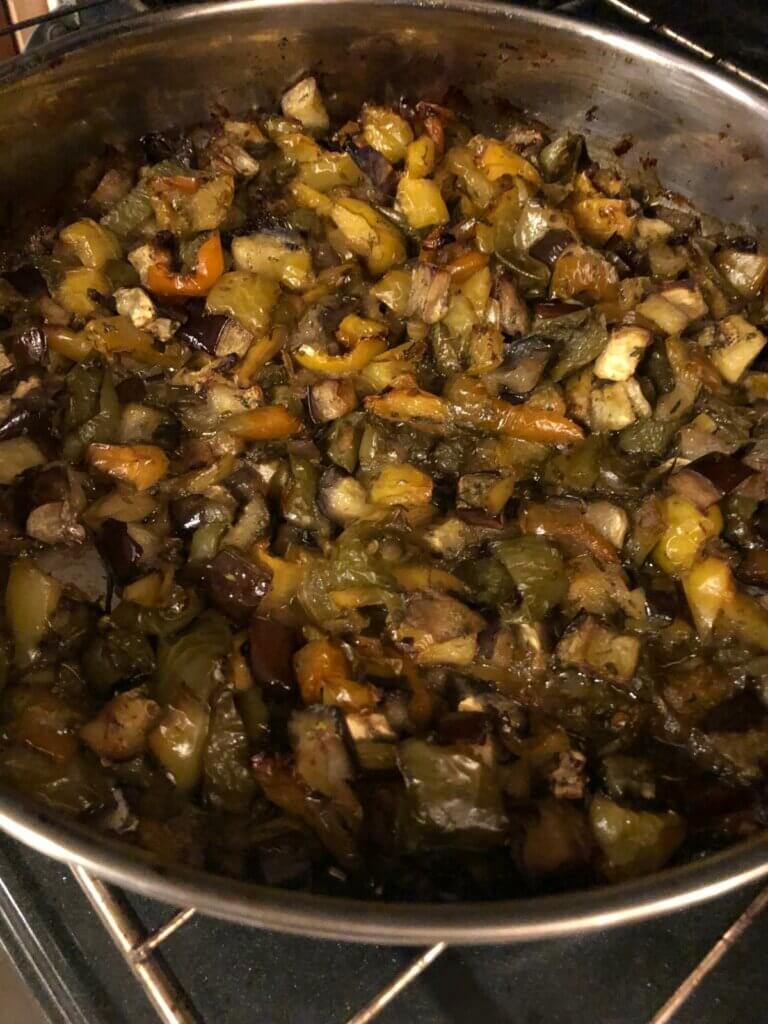
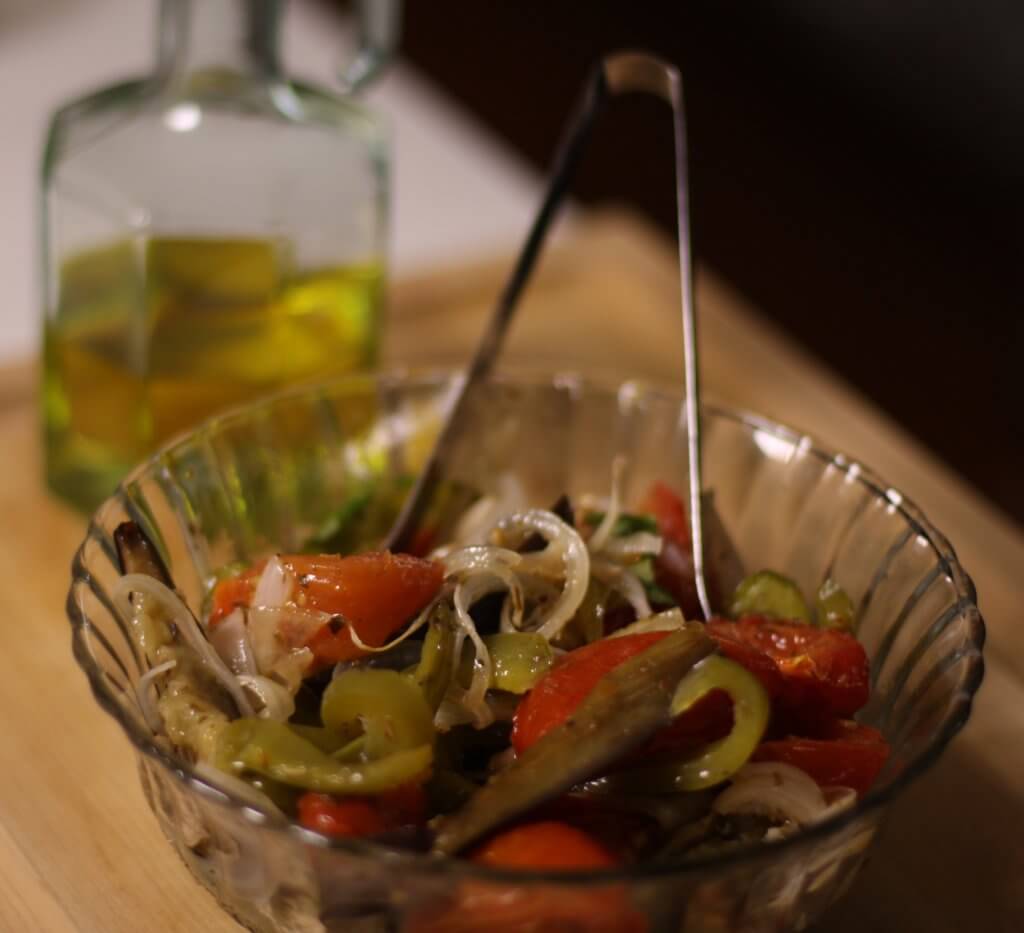
Bake at 350 degrees F for 40 minutes- at the 20 minute mark, pull it out and mix it all up to move the oil around and be sure nothing dries up.
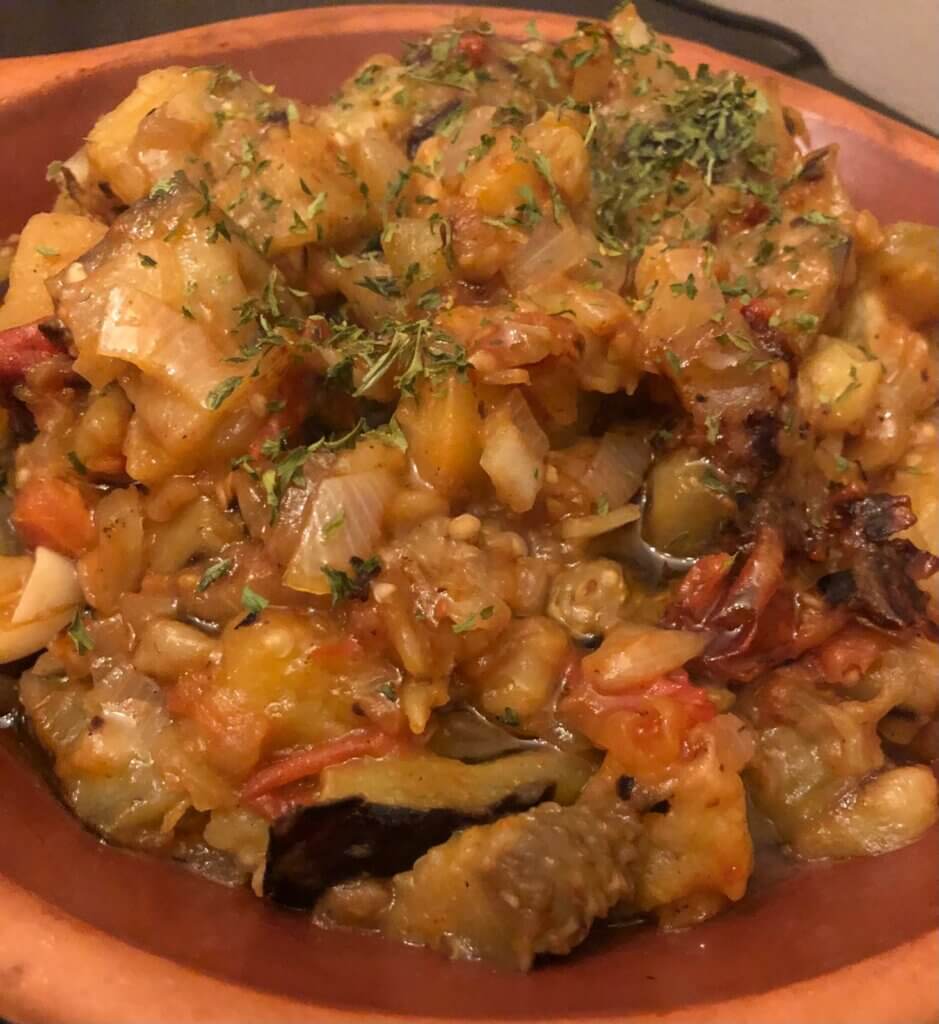
After 40 minutes or so, it should look like this.
Our favorite way is to eat it over rice, but you could also serve it with pasta or rustic bread.
Roasted Eggplant & Pepper On Rice
This is such a straightforward, mess-free dish to make.
Makes 4 servings
INGREDIENTS
1 eggplant, half peeled
4 cups sliced peppers- mixed colors or just green ones
Mix the eggplant and peppers so they are thoroughly combined and place them in an oven-safe dish large enough to spread it out so that they’re not too crowded.
There are some really wonderful pastry and baking dishes found in French, Italian, Latin, Asian and American cuisine that call for alcohol and liquors, so if you’re following a Halal diet, or you just want to eliminate alcohol from a recipe (i.e. meals for kids), I’ve come up with a list of all natural Halal substitutes for those – and the results are so delicious! You can get some of the classics in the My Halal Kitchen cookbook. Click on the chart to get the PDF, which you can download, print and hang on your fridge!
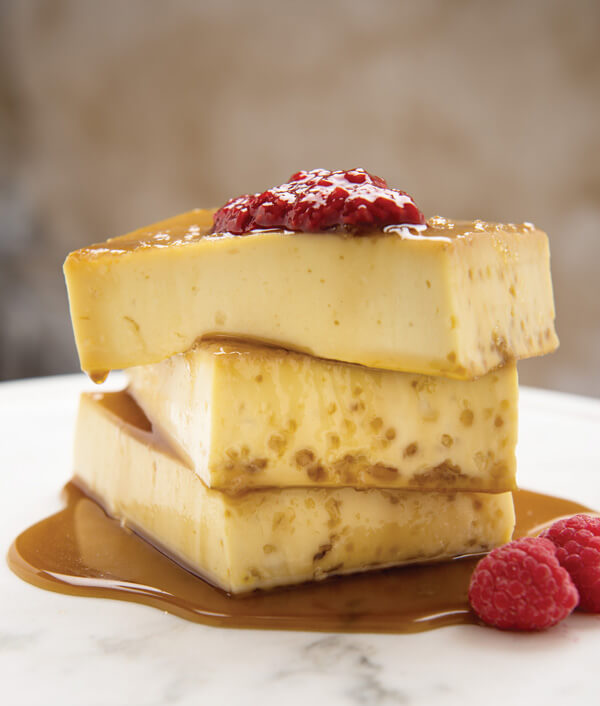
To print a copy of the chart above, click on it.Raspberry Flan in the Latin chapter of the My Halal Kitchen cookbook
Disclaimer: This post contains affiliate links, which means I may earn a small commission if you make a purchase through these links at no extra cost to you.
So many people end up avoiding restaurants, recipes and other great family meals because they’re often times unaware of the ways around consuming pork and that there are plenty of fine substitutes that can be used in classic Italian,French, Latin,Asian, and all-American dishes. In the chart below, I provide such substitutes that can be used that really add flavor and depth to dishes, so there is no sacrifice on the taste. In fact, you’ll be mighty surprised how delicious recipes turn out with the suggestions I’ve given. See for yourself with the recipes you can experiment with in the My Halal Kitchen cookbook.
Simply click on the chart, download the PDF, print and hang it on your fridge or save it in your favorite recipe files to help you in the kitchen!
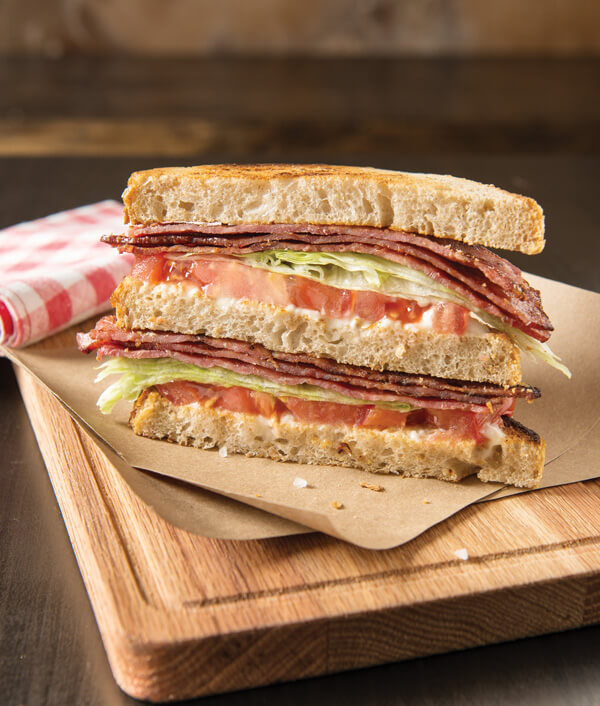
Halal BLT from the My Halal Kitchen cookbook
Disclaimer: This post contains affiliate links, which means I may earn a small commission if you make a purchase through these links at no extra cost to you.
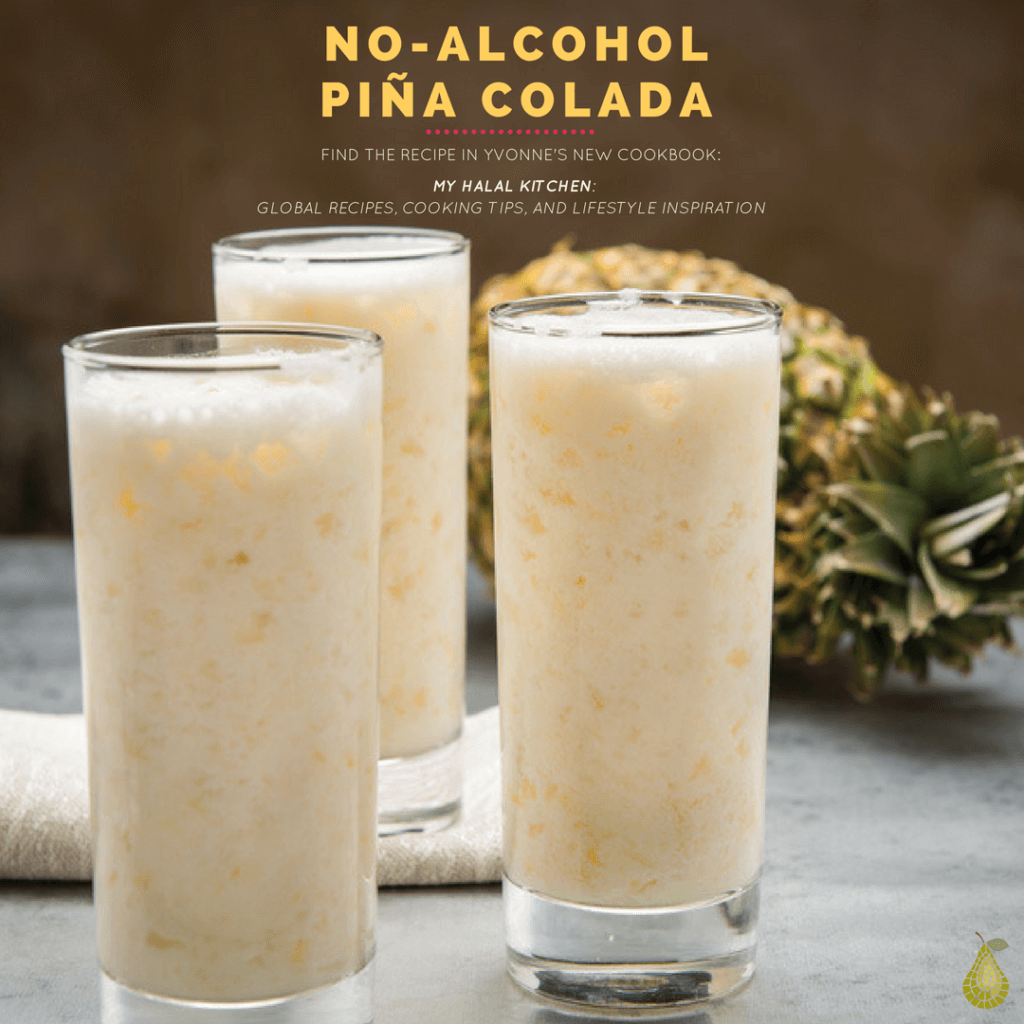
It’s a common myth that alcohol burns off completely in the cooking process. Yes, some of it does, that is true. When I was writing the My Halal Kitchen cookbook, it was an essential part of my research to gather the scientific evidence to be able to support this notion. Islamic dietary guideline dictate that alcohol and all of its byproducts are not permissible in a Halal diet, so even a small amount of it is considered najs (impure) and therefore haram, or impermissible- the complete opposite of halal. That said, I was able to find the data backed up in the USDA Table of Nutrient Retention Factors, Release 6, which is included as a chart in my book. Below is a chart I’ve created to make it easy for you to use in dishes that call for a variety of alcoholic beverages in cooking and in making drinks- so you can have a wonderful fruity non-alcoholic mojito, pina colada and more- which is delightful and opens up a whole new world of alcohol-free dishes from Italian, Latin, French cuisine, as well as juicy mocktails. (To get my recipe for alcohol-free Pina Colada, you can find that in the My Halal Kitchen cookbook, as well). Simply click on the chart, download the PDF, print and hang it on your fridge or save it in your favorite recipe files to help you in the kitchen!
Spaghetti Carbonara from the My Halal Kitchen Cookbook – Italian Chapter
Disclaimer: This post contains affiliate links, which means I may earn a small commission if you make a purchase through these links at no extra cost to you.