Beef Samosa Puff Pastries

Beef Samosa Puff Pastries

If you’ve never tasted keema, or that wonderfully spiced Indian-style ground beef, you’re totally missing out on some great flavor. Surely every family makes it a little different- even I have a few different versions, but for samosas I like to recreate a certain flavor.

add meat and spices

The first time I ever had it was at a suhoor in which I was a guest at a Muslim family’s home- it was my first experience staying overnight where I got to experience how suhoor was eaten in a Pakistani family and it was a fascinating one. 

Ingredients for Beef Samosa

They served finely ground beef with freshly-made chappatis and carrot halwa, which is sweet. I will never forget all those flavors- it’s not anything I would have ever thought of eating, but I was hooked on the aroma, the taste and how satisfied I felt, making me strong and ready to face a day of fasting in Ramadan.

garlic ginger

This time around since I’m making samosas (similar to latin-style empanadas), I use some pretty standard spices and ingredients that are kind of a must in samosas, although peas and potatoes aren’t exactly two of them- I like them and may even make them only with potatoes next time. You could leave them out of this recipe, if you like. I’m also baking these, not frying them. 

spices for beef samosa

Spices: garam masala (mixture of black peppercorns, black cardamom seeds, mustard seeds), cumin powder, turmeric powder, chili powder, coriander powder, sea salt.

cut up chili pepper

Fresh ingredients: garlic/ginger paste, freshly cut jalapeño/green chili, freshly chopped cilantro, yellow or white onion, diced yukon gold potatoes, frozen peas.

yukon gold potatoes all cut up

We also need a great quality dhabiha halal ground beef. In this recipe, I use Midamar Halal’s USDA organic beef.

organic beef


*Sidenote: One tip I’ve learned in terms of how to get the beef to be really, really fine if you don’t have a grinder, is to use a potato masher when cooking. You can do that if you don’t use potatoes in this recipe, otherwise, you’ll mash the potatoes, too.

I make the garam masala fresh, but you can also find it in most Indian stores already packaged up. I did not have mace so it’s not a part of my mixture, but you can definitely add it.

I use a coffee grinder to make it and clean it out in between grinding spices and coffee with a piece of fresh bread- works wonders! 

making garam masala

It looks like this when it’s all ground up:

finished garam masala

Then mix it up with all of the other spices so that they’re nicely combined and easy to add to the meat while it’s cooking. It’s good to have this ready ahead of time so they’re all incorporated at the same time.

mix all spices

It’s so pretty when mixed together, and smells amazing- smells like samosas-in-the-making to me!

add garam masala

To make the keema (ground beef), heat the oil gently. You can use olive or vegetable oil. If you’re making the samosas with potatoes, salt the oil at this time- it will help the potatoes to not stick to a non-stick pan. 

add salt to pan

Once the oil is nicely heated (but not burning), add the diced potatoes.  Good idea to have this done way ahead of time, as you don’t want this heating up to much before you add the potatoes.

add potatoes
Let those cook for some time, about 4-5 minutes, using a spatula to move the potatoes around and help them use the salt to not stick to the pan. 

Next, add the onion and cook until transparent then add the meat and all the spices. 

add spice to the meat


The frozen peas are added last to prevent them from getting mushy.

onions and peas

After the meat has cooked for about 15 more minutes (and you’re continuously crushing up any bits of meat, since it should be finely ground), add the peas.

stir

Now is the fun part! After the meat has cooled, you’ll be making the puff pastries and prepping them for baking. You need one package of puff pastry, two if you want to use up all the meat. One package makes about 12 pastries. Most will need to be cut into six pieces (two sheets come in a standard package), as seen below.

place puff pastry on floured surface

Since the meat is cooled, add about 2 tablespoons to each piece.

place meat in middle

Fold each one over and crimp three edges with a fork (not the folded-over part). 

fold over

Use an egg wash (one egg with 1-2 tablespoons whole milk), whisked.

add milk and brush

Two people doing it goes a lot faster.

two brushes makes it go faster

Now brush the tops generously. 

brushing each oneThis will help them to look golden when they’re baked- you want that! 

cover completely in egg washOn a parchment-lined baking sheet, place six,  a few inches a part, to give them room to grow.

six to a tray
Bake at 400°F for 25 minutes.

baked

I only use the top shelf in my oven. When I used the bottom, they didn’t puff well and went flat, so be sure to do the same. 

puffed up

The hardest part is waiting for them to cool off before trying them- if you open them too early, they’ll also flop. Just let them cool a few minutes and enjoy!

finished samosas

 What’s your favorite way to enjoy a samosa? Baked, fried, with potatoes or without, with peas or without? Any special spices you must include? As always, I’d love to hear from you!

Lukhmi: Minced Meat Savory Samosa, Hyderbadi Style

Lukhmi: Minced Meat Savory Samosa, Hyderbadi Style

This Ramadan recipe comes to us from Lubna Karim, the India-based and very talented food blogger and photographer of  Kitchen Flavours. Make them for Eid, too, or simply any time of year…

DSC02027

After many years I am at mom’s place during Ramadan, so the celebration is doubled. My mom loves to make so many different Iftar recipes and we love devouring them. So, when Yvonne asked me to do a guest poston the occasion of Ramadan, I asked her if there was anything in particular she is looking for.  She said some sort of Indian Samosas, so I told her about ‘Lukhmi’, which she wasn’t too familiar with but wanted  to know more about how to make them.

http://www.kitchenflavours.net/

My mom made it a point to make Lukhmi twice a week this Ramadan, so I tried to capture her every moment in making them to share with you.

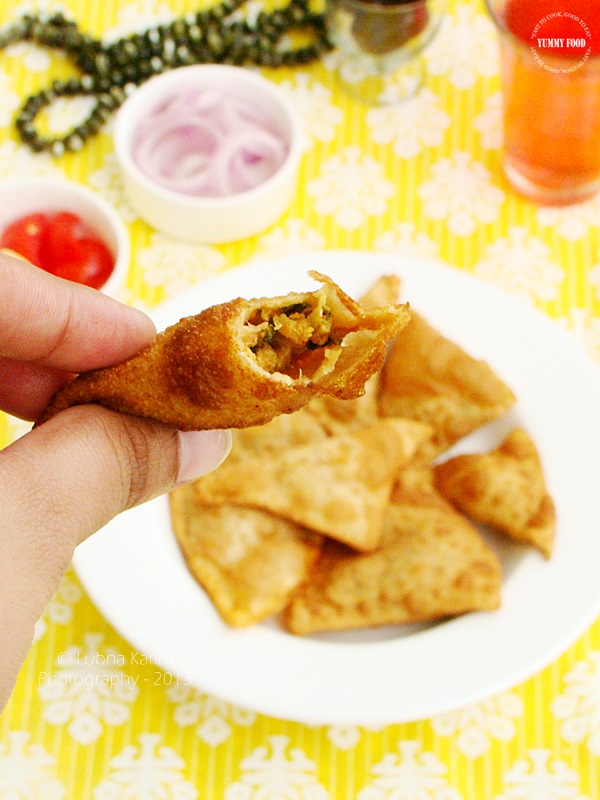
Lukhmi is a typical odd-shaped samosa, mostly served as a starter in typical Hyderabadi weddings. The filling is made with minced lamb meat and other minimal ingredients. The outside is made by combining all purpose flour, whole wheat flour and semolina. The filling has everything that Indian taste buds crave- simple, spicy, tangy. The outside is crisp, soft and chewy. We relished these hot lukhmi with sliced onions, tomatoes and lemon wedges along with dates and refreshing sharbat-e-roohafza.

Here’s the recipe.

INGREDIENTS 

Filling Ingredients

1/2 pound (1/4 kilo) qeema/kheema/minced Lamb meat

1 onion, finely sliced

½ tablespoon ginger-garlic paste

1 tablespoon red chili powder

¼ tablespoon turmeric powder

2 tablespoons lemon juice

1 green chili, finely chopped

Salt

2 tablespoons  coriander leaves, finely chopped

Oil

Lukhmi Ingredients

1 cup all-purpose flour/maida + ½ cup for dusting

1 tablespoons whole wheat flour

3 tablespoons fine semolina

Salt

1 tablespoon vegetable Oil

Water


Preparation

http://www.kitchenflavours.net/

Cooking the Kheema

Mix khema with ginger-garlic paste, red chili powder, turmeric powder and salt. Leave for ½ hour covering with cling.

Heat oil in a heavy bottom cooking vessel and fry onions till translucent. Now add the above marinated khema and fry for 3-4 minutes on medium flame.

Now add chopped green chili and cook covered until khema is completely cooked. Remove from flame and add chopped coriander leaves. Set aside.

Add lemon juice just to this mixture just before you start filling.

Cooking the Lukhmi

In a mixing bowl, add maida, whole wheat flour, semolina, salt and oil. Combine slowly by adding water. Knead until you get a soft ball.

Cover with cling and leave for 30 minutes. Knead for another 2-3 times until you get very soft dough.

Pinch a lemon size ball from the dough and roll into thin circle by dusting with flour.

Now using sharp kitchen knife make 2-3 cuts (as shown in the picture above) and start to add filling. Grease the corner of the lukhmi by wetting your fore finger.  Press the edges of the lukhmi with your fingers to ensure it is tightly sealed.

Bring the ends together (as shown in the picture above). This gives you a nice triangle. You can alternatively cut the lukhmi into squares too.

Heat enough oil for deep frying in a heavy bottom cooking vessel and slowly drop down the lukhmi’s one after the other.

Fry till golden brown on both the sides and take out on wire mesh strainer. Serve hot.

NOTES:

Alternatively you can even crimp the edges of lukhmi with fork.

You can even knead the dough with lukewarm milk.

You can even make the minced meat filling ahead and store in the freezer in a zip lock bag. Just thaw it before you start to make lukhmi.


Thank you Yvonne for having me as your guest today…..

May the Ramadan bring you peace and prosperity, good health and wealth and brighten your life forever. Have a blessed Ramadan.


Cilantro Chutney

Cilantro Chutney

One of the very first Indian dishes I ever tried were samosas and their corresponding chutneys- one sweet sauce made with tamarind and the other with cilantro. Often times when you visit an Indian restaurant, it’s one of the appetizers; it’s also a common trio to be served within the Indo-Pakistani community at Iftar time, or at the breaking of the fast during Ramadan, just before the main meal is served. To me, it’s always a reminder that Ramadan is here and I absolutely love the crunch of the samosas with the pungency and freshness of the cilantro chutney the most.

cilantro chutney up close

And, fortunately for us, it’s not hard to make at home. All you need are a few simple ingredients and a blender or food processor: fresh cilantro, lemons, jalapeños, garlic, salt and sugar- to add just a little sweetness.

basic ingredients

I take the very bottom of the stems off the cilantro, but otherwise leave the stems intact- they’re totally edible and don’t make anything bitter like some other herb stems might.

chopping cilantro

I also cut the tops off the jalapeño before proceeding to remove the seeds.

chopping up the jalapeno

Some people like to keep the seeds in, which makes the dish considerably ‘hotter’ (spicier). If you like that, skip the next step.

removing seeds from jalapenos

Next I wash everything really well. My favorite thing to do is to spray white vinegar on everything before rinsing in cool water- it serves as a natural anti-bacterial agent.

wash all produce

The lemons should be cut in half and squeezed over the top of the ingredients before processing. If you like it a little less tangy, try one lemon first, then if you want more, add the juice of the second one. I prefer the juice of two lemons, personally.

cilantro chutney in food processor

And that’s it- once it’s blended, you’re done. You can refrigerate until serving but I would bring it to room temperature before doing that. It’s not going to go over well to have nice hot samosas with cold chutney, in my opinion.

saffron road vegetable samosas

Here’s the really delicious part- you don’t need to slave over a hot oven during this hot summer Ramadan. Get the Saffron Road‘s Vegetable Samosas instead. They’re super easy to make. Just pop them into the oven for about 22 minutes then you can shut it off and cool your kitchen back down again.

box saffron road samosas

You’ve already made a homemade chutney to go with it, so if you’re in that mid-Ramadan cooking slump, this is the perfect way to make a semi-homemade appetizer for your family or for an Iftar party.

samosas baking

And, they’re really good. The phyllo is soft and buttery, so there’s no skimping on quality ingredients here. That’s important to me, because if I want something convenient, I don’t want to sacrifice taste or the quality of the product, which to me translates to what is healthiest for myself and my family.

inside saffron road's samosas

Wouldn’t you agree?


My Halal Kitchen is proud to be a Brand Ambassador for Saffron Road Foods.