I think eggplant might just be the quintessential Mediterranean vegetable. You find it in every Mediterranean country’s cuisine in such a variety of absolutely delicious ways. My personal favorite is when yogurt is added, which I believe is a particularly eastern Mediterranean way of eating it (i.e. in Greece, Turkiye, and many other similar regions).
I’ve had it so many ways in so many different types of cuisines that I can hardly pin down a ‘favorite dish’ but I do have a preferred flavor profile in terms of how it’s cooked and I think I love the way it’s presented in Turkish cuisine the most because of it’s grilled taste, even when roasting in the oven – as well as the other ways its cooked so often with tomato and garlic, which is very similar to my Sicilian heritage way of making it), and that addition of yogurt is my favorite.
When cooking this way, you barely miss meat in a meal, so it’s a great option for vegans and vegetarians as well as anyone who is skipping out on meat for any particular meal.
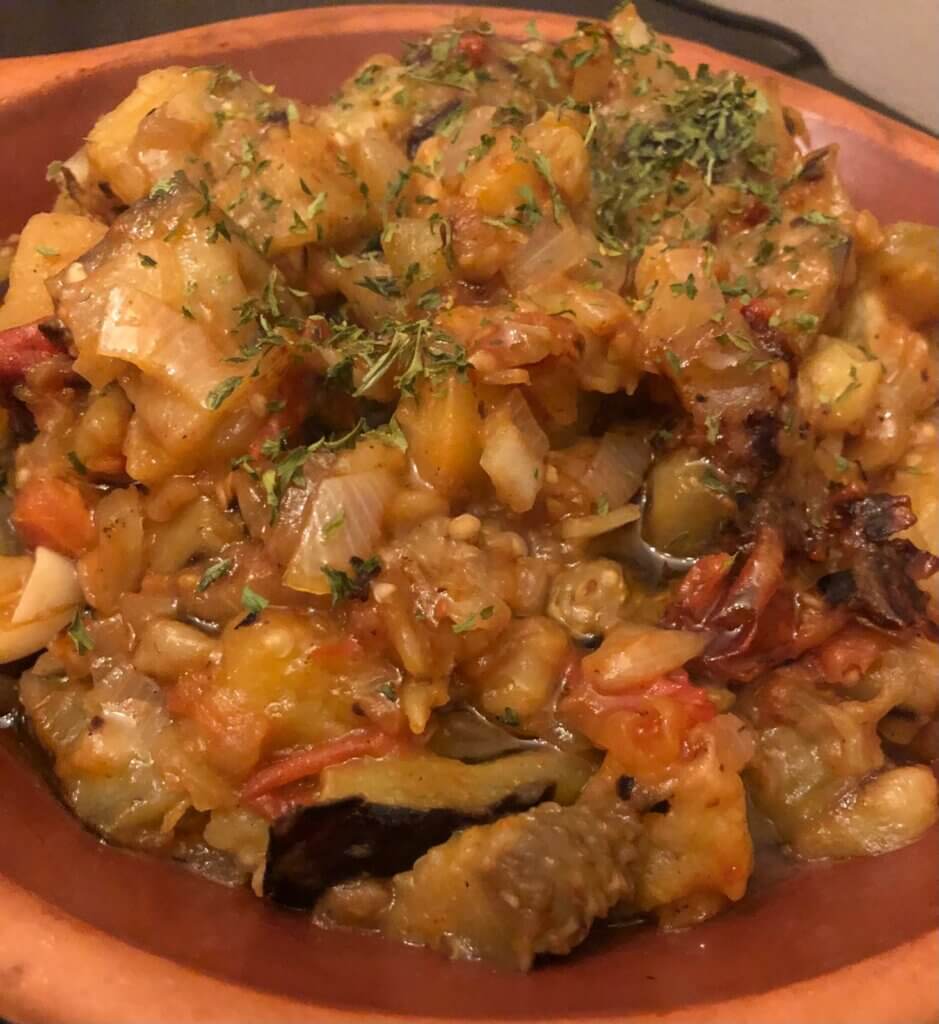
Sauteed Eggplant Mezze Recipe (Mediterranean)
Serves 4-6
Ingredients
2-4 tablespoons extra virgin olive oil
1 large eggplant, cubed
2 tomatoes (peeled), roughly chopped
1 small onion, chopped fine
3-4 cloves garlic, crushed
2 tablespoons tomato paste
Sea salt, to taste
Freshly ground black pepper
Whole milk yogurt (optional)
Crushed red pepper flakes (optional)
Directions
To a large saute pan or Dutch oven, add the olive oil and gently warm it. Add the eggplant and brown on each side, about 6-7 minutes. Next, add the tomatoes and onion at the same time. Continue to cook until the juice of the tomatoes has evaporated, stirring continuously as it cooks. Add the sea salt and black pepper, too.
Allow this mixture to cook for about 12 minutes, uncovered. Once all of the ingredients are soft and thoroughly cooked, turn off the heat and cover for about five minutes. Remove the lid and let cool slightly. Serve, as desired, either as-is like this or with a dollop of yogurt, sprinkled with red pepper flakes. You can also add a drizle of olive oil, freshly cut parsley.
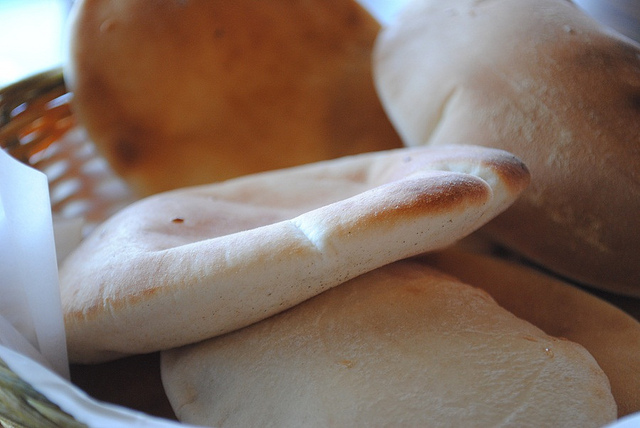
Enjoy with some freshly baked pita bread or khubz (Arabic style bread, which is hefty enough to pick up this dish!).
Note: this is also considered a popular “cold” dish, meaning that it doesn’t have to be piping hot to be eaten and it’s also preferred this way a lot of times, as well.
This post may contain affiliate links, which means that I may receive a commission if you make a purchase using these links. As an Amazon Associate, I earn a commission from qualifying links.This post may contain affiliate links, which means that I may receive a commission if you make a purchase using these links. As an Amazon Associate, I earn a commission from qualifying links.
Everyday Mediterranean Culinary Newsletter by Yvonne Maffei is a reader-supported publication. To receive new posts and support my work, consider becoming a free or paid subscriber.
Have you ever come up with a dish that is so tasty you think you invented it yourself, only to find out later that it’s actually one of the great national dishes of not one but many different nations?
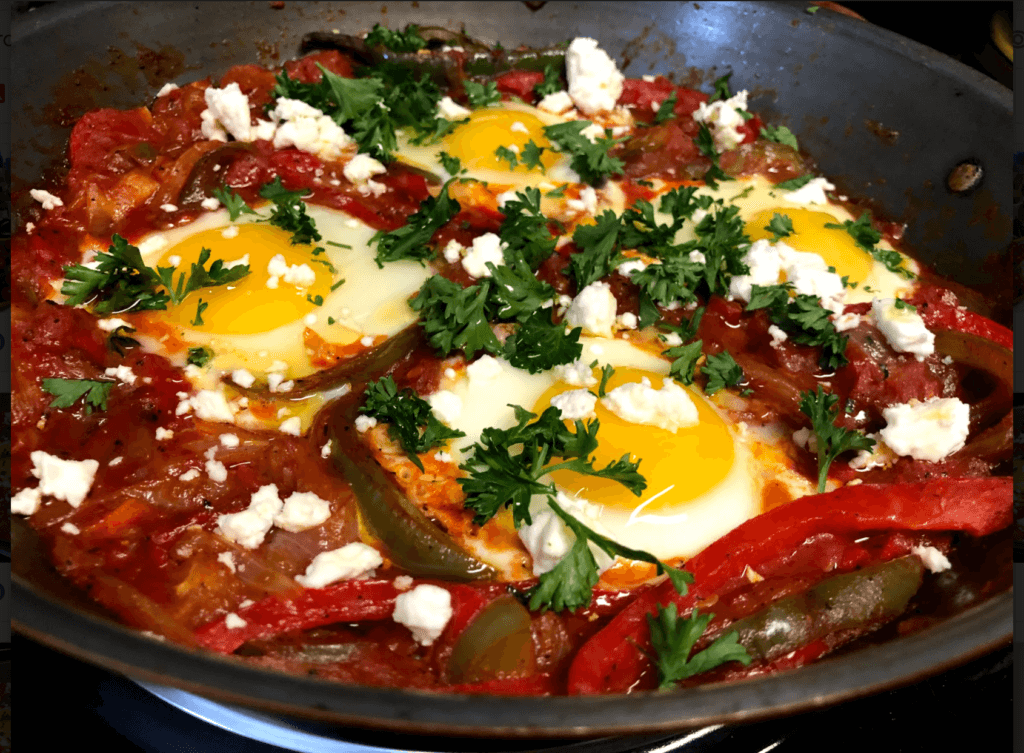
Well, that happened to me when I thought I was a culinary genius for coming up with the most delicious breakfast egg dish I’d ever eaten. I was simply using leftover ingredients that I had on hand from my mostly Italian/Sicilian/Mediterranean cooking. Well, little did I realize that everywhere from Palestine to Turkey to Lebanon and Algeria, everyone has been making this dish, or something very similar to it: Shakhshouka (also spelled Shakshuka).
In Turkey, the same ingredients (onion, peppers, tomato sauce) are used but the eggs are scrambled and the dish is called Menemen. An Italian version might use leftover tomato sauce, and in Algeria or Morocco they spell it Chakchouka. In some Middle Eastern recipes they add nutmeg; I do not ever put nutmeg in mine.
I recently worked on a video project for American Muslims for Palestine called Turning Tables, so watch out for that to be published in the near future. I was asked to make a Palestinian recipe or one that was inspired by Palestinian cuisine, so I decided to make my version of Shakhshouka, inspired by the cookbook, The Gaza Kitchen by Laila Al-Haddad, which now has a new and updated version.
Gently warm the olive oil in a large saute pan. Add the onion, green and red peppers and jalapeno. Cook until the peppers have softened. Add the sea salt and ground pepper as they cook.
Add the tomato paste and swirl around the pan to dissolve it as much as possible. Add 1-2 teaspoons of water to thin it out. Add the paprika. Cook until the water has mostly evaporated.
With a wooden spoon, carve out 4 round spots in the pan and crack one egg into each spot. Reduce the heat to medium-low and let cook until the white membrane of the eggs have cooked and whitened.
Remove from heat and drizzle the dish with olive oil, the crumbled feta and chopped parsley. Serve family style on a hot plate on the table, with fresh and warm pita bread.
Bismillah and Sahtein!
You can see a slightly different, faster version that I made for breakfast recently and posted on my Instagram page:
After having lived in Turkey for a good amount of time, I have been enlightened about the art of making baklava. It’s such a dessert that when made well and with the finest ingredients, is something you really do savor. It’s special. That’s why it’s the perfect celebration food, making it my choice for making on this year’s Eid ul Fitr.
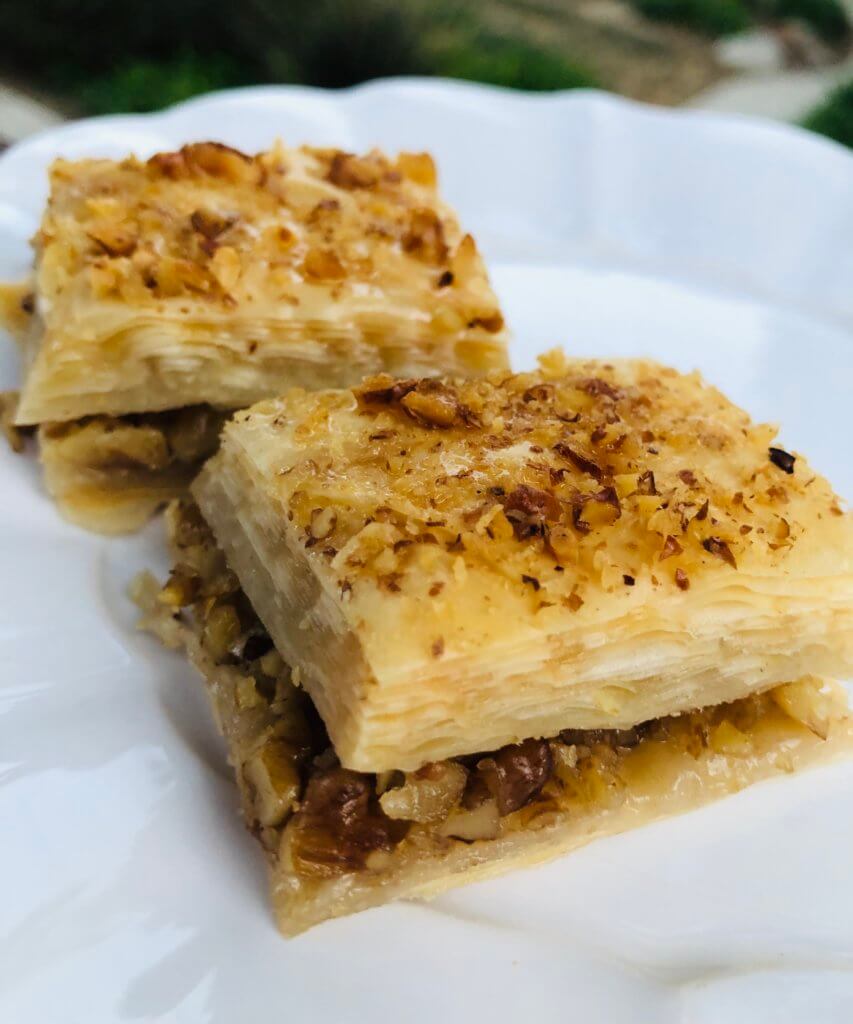
Walnut Baklava with Rose Syrup on Top
You can see the variations in the notes section, and of course I’d love to hear from all of you on how you like your baklava and what you do to make it your own and special, too. To me, this recipe is one of my absolute favorites because I just love the scented aroma that filled my kitchen when this was baking, and the taste combination of walnut with rose water is sublime.
Makes approximately 50-60 pieces baklava
Special equipment
Silicone pastry brush
Full sheet pan size 13” x 18”
Dampened cotton kitchen towel
Notes on this recipe:
If you want to make a smaller batch or use less phyllo, you can cut this recipe in half and use a half sheet pan instead of a full sheet pan.
Most phyllo is sold frozen, so it must be defrosted in the refrigerator at least one day prior to making this recipe.
You don’t need to brush every single layer of phyllo with ghee; you can instead brush every 2-3 layers.
The ghee or butter should be fully melted for best results
Caster sugar/superfine sugar produces the best result, but if you have regular or cane sugar, you can work with that, too.
Instead of rose water, you can use cinnamon in the nut filling instead; not in the syrup (same amount).
Instead of rose water to make the syrup, you can use orange blossom water or simply lemon juice (same amount).
Instead of walnuts, you can use pistachio or hazelnuts for great flavor.
If you have allowed your baklava to cool before adding the syrup, warm up the syrup and pour on top. At least one of the items should be hot for the syrup to set in very well, but not both.
To organize the process, I like to make this recipe in the following order:
Step 1: Preheat the oven
Step 2: Make the syrup
Step 3: Make the nut filling
Step 4: Butter the phyllo dough, proceed to finish
To a small saucepan, add 1 ¼ cup caster sugar, 1 tablespoon rose water, and 1 ½ cup water. Bring to a boil, then immediately reduce heat to medium low and cook for 20 minutes.
Remove from heat and set aside as the last step in this recipe.
To make the nut filling
To a bowl, add the nuts, 1 tablespoon caster sugar, and 1 tablespoon rose water. Mix well with your hands to make sure everything is combined well.
Set aside.
To make the phyllo
Preheat the oven to 350 degrees Fahrenheit.
Unwrap the phyllo and spread it out flat. Place a damp cloth on the top layer so that it doesn’t dry out while you are working. Do this with every layer you leave exposed.
Brush the sheet pan generously with ghee. Add a phyllo sheet and brush it with ghee. Repeat with 14 more sheets for a total of 15sheets before the nut filling is added.
Pour in the nut mixture (2 ½ cups ) and spread it out evenly across the phyllo. Add one new phyllo sheet on top and brush with ghee. Repeat this until you have a total of 15 more sheets on top, for a total of 30 sheets.
Add the ½ cup chopped walnuts to the top.
Using a sharp, smooth knife, cut the entire sheet in several long, even strips and then again diagonally, which will create diamond shaped pieces.
Bake for 40 minutes.
Remove from the oven and pour the cooled syrup on top. Let sit for about 15 minutes before cutting and serving.
I’m a huge fan of yogurtfor a whole host of reasons- and not just eating a small cup of flavored yogurt a day, but eating it as part of a healthy diet in as many ways as possible. When I buy a tub of yogurt, I find all sorts of ways to finish it off because I see it as a valuable health food that I’m grateful we have so readily available to us. That said, from a halal perspective, nowadays you have to read labels to know if there is any gelatin in your tub of yogurt. Yes, gelatin. Which can come from either beef or pork, but could also come from agar agar, a sea-derived gelatin. Either way, if it’s made in a homemade style, it is not made with any of those. The reason it’s often done in the food industry is that it helps to keep the yogurt conformed in the tub or container and to withstand varying temperatures during transport.
One solution to that is to buy a halal-certified yogurt and there really aren’t many brands on the market to fit that category, however, I have been consuming and developing many wonderful recipes with Mountain High Yoghurt, a halal-certified brand available at many stores- widely available in the Western states, but I find the larger tubs available at my local Costco store just outside of Chicago. It’s nice and creamy, smooth and clean of any ‘funny stuff’ or doubtful ingredients. They make it without any gelatin, which I believe is how yogurt tastes best anyway. I have been delighted by this new find!
Have you ever bought a tub of yogurt and then got to the last part of it and wondered what you could make or bake to finish it off? I make a conscious effort to never throw away any food, and yogurt is something that can easily be incorporated into so many dishes so that you never waste a drop. After all, the barakah, or blessings, are in the last part of any vessel…
In this case, when I’m looking to use the last drops of yogurt in the tub, I think of sauces- sauces on meat, sauces on pasta- either purely yogurt or mixed with something else, both of which can be amazingly delicious. I remember the first time I ever had yogurt on top of pasta with red sauce because a Turkish friend of mine in college had poured it on top of my plate. I felt as though it was a mortal sin to do this, having grown up in a Sicilian family where the only thing that went on a plate of past was some sort of Italian hard or soft cheese, that’s it. I didn’t want to be rude to my host, so I ate it. And absolutely loved it, so much so that I kept this way of eating pasta my very own secret for a very long time. Eventually, I found myself making pasta with yogurt more than with red sauce, as my best friend often made macarna (macaroni) with yogurt for her kids and we would sit at the table with them together often and eat this up as though it was the new comfort food, at least in my life. I guess food memories really do create the bond we have with certain dishes, don’t they?
(share with us how you #finishthetub by using that hashtag and tagging us on social media)
This recipe is a whole new spin on my love for Middle Eastern meat dishes. It combines a whole lot of flavors I love and piles it all on to one plate, which is fantastic, in my opinion. When the combination of beef and eggplant is mentioned, I’m in for pretty much whatever dish it is, having first been lured into its greatness by my dear friend Inci who would present Ottoman-style dishes at my door when we were neighbors many moons ago. She would explain their history and tell me how she made the stew cuts with the eggplant so silky and soft, but I could never quite replicate the texture or taste. To this day, it’s the one thing I ask her to make when I see her, as I really love her dish the most, especially when served with the perfectly-formed buttery rice with strands of toasted vermicelli. How spoiled I’ve become over the years having excellent home chefs as friends…
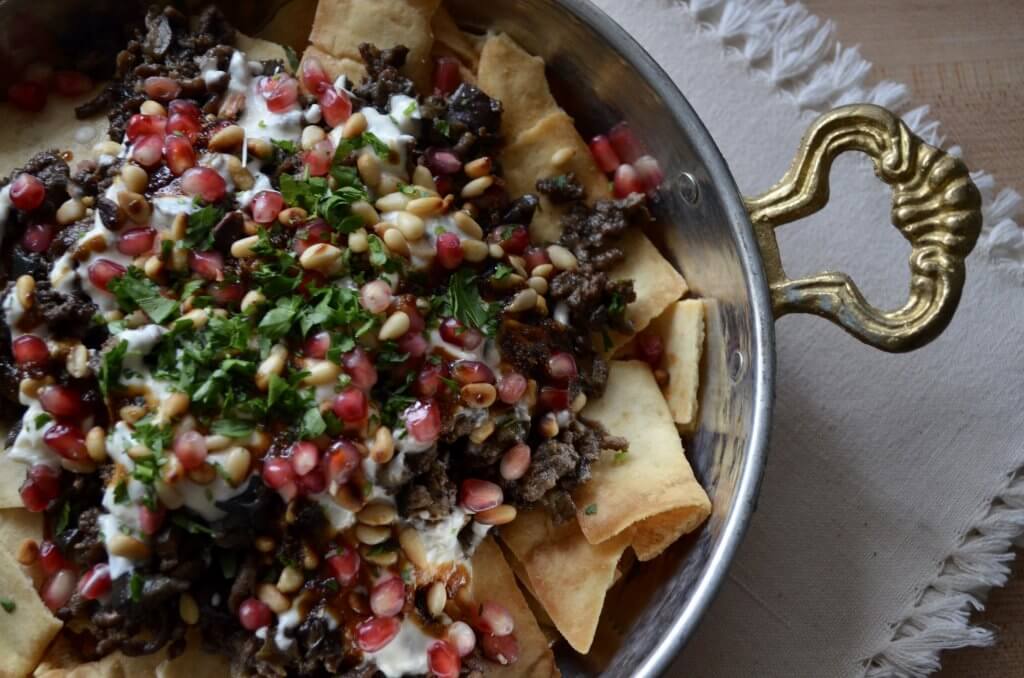
Anyway, I first heard about this particular ground beef dish while listening to an episode of Nigella Lawson’s cooking show. I had never really watched her before and all of a sudden I started to watch her programs with interest because of the variety of Turkish and Lebanese recipes she was showing how to make, using many of the ingredients I also cook with and have on hand much of the time at home. One dish that stood out, in particular, was her recipe for Fatteh, something which she also called Middle Eastern nachos- and it’s true- they do look and feel a bit like making a nacho dish although here the meat is flavored with Middle Eastern spices instead of Mexican ones. Genius. I thought I’d give it a go and ended up making dishes for a couple of weeks, experimenting in my own way and coming up with a style and format I love so much I’ve served it to my guests who also loved the yogurt sauce on ravioli, which you’ll see at the end.
Here’s how the Middle Eastern Beef is spiced up, the eggplant is made and of course the yogurt-tahini sauce, which to me tastes a lot like something you’d find on a certain halal cart somewhere around the country. I’ve been asked so often for that yogurt sauce recipe and this is the one way I feel as though it tastes the closest to the cart.
First, I make the yogurt sauce, although you can do the beef and eggplant first instead. If you like the yogurt sauce warm when eaten, do it last. If you don’t care, then it won’t matter when you make it.
You need to use a double boiler or make one as I’ve done here. A pot of water on the bottom and a stainless steel bowl on top where the yogurt, tahini, garlic cloves and salt will go. Also the lemon juice at the end.
I warm the yogurt first, as the water in the bottom pan has come to a boil.
Then I add crushed garlic, tahini sauce, salt and the juice of half a lemon.
It’s whisked all together and warmed gently, then taken off the heat.
Next, I dice up the eggplant to make sure all the pieces are about the same size so that they cook evenly. Since they soak up oil quite a bit, I use grapeseed oil to saute them in first, then once fully cooked I move them out of the pan and onto a plate, set aside until the ground beef is done. The ground beef is cooked in the same pan with the cumin, coriander and dried parsley.
Prepare some pita chips, either store-bought or make your own.
Use the pan or dish you’re going to serve the meal in to line it with the pita chips. I actually keep the center hollow of any chips if I don’t have enough to go around, and it’s fine.
Now come the added ingredients that if you have can be great, but if you don’t you can skip them, but find something crunchy to put on top, as well as something picante, or hot.
Like Aleppo pepper flakes or Urfa biber. I bought some on my recent trip to Turkey and the others at the Spice House in Chicago and it’s excellent.
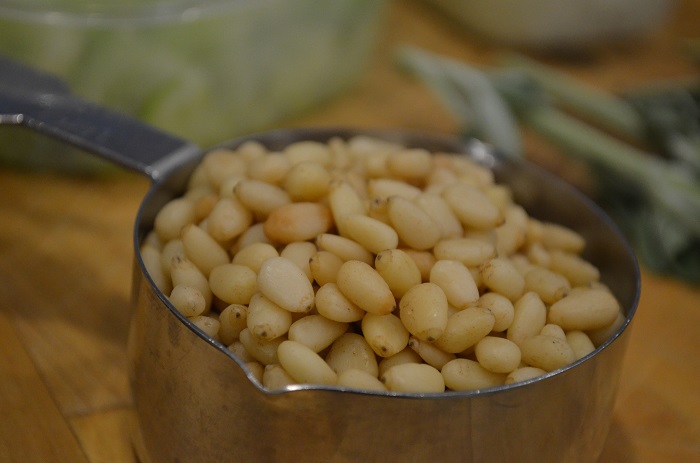
Dry roast the pine nuts in a pan, without any oil or water (which is why it’s called dry roast). Do this for about five minutes or less, on low. Keep a careful eye on it and pull it off the heat when they’re mostly browned. Don’t skip this step; it makes a huge difference on this dish.
And…ripe pomegranate seeds.
They’re not really in season right now, so I was realized that only when opening mine. The color was really light; otherwise, it’s nice and dark. I love the way they burst with flavor in your mouth in this and any other dish where fresh pomegranate seeds are used. If you can’t get these, you can add my other favorite ingredient here: grape molasses. Actually, I used both in this dish because of the grape molasses which adds a sour flavor, and I love it. You can get most grape molasses products in a Mediterranean or Middle Eastern stores in the honey aisle or where they keep Turkish products. Pile it all on top and add fresh parsley. I love the color combo, don’t you? Naturally, I had to plate this in my copper pans brought from Turkey; they’re perfect for this dish.
Now, there is one variation you can make here. If you don’t have eggplant, just use the beef, or lamb, or ground chicken or turkey- although I feel this recipe tastes best with either lamb or beef. The point is, you can make it with eggplant and I realized this the first time I made the dish and forgot to add that important ingredient, but it was fine. It was totally fine and even quicker to make!
One other thing you can do to #finishthetub is to put the yogurt-tahini sauce on top of cooked ravioli. This particular dish below is made of butternut squash ravioli and then creamed spinach on top, then topped with the yogurt-tahini sauce. You can warm just the yogurt if you don’t want to add all the other ingredients and then put the toasted pine nuts on top.
Either way you make it, you can #finishthetub in tasty, quick ways. How do you do it?
This is a Guest Post by Sweet Pillar Food Founder, Nadia Hubbi
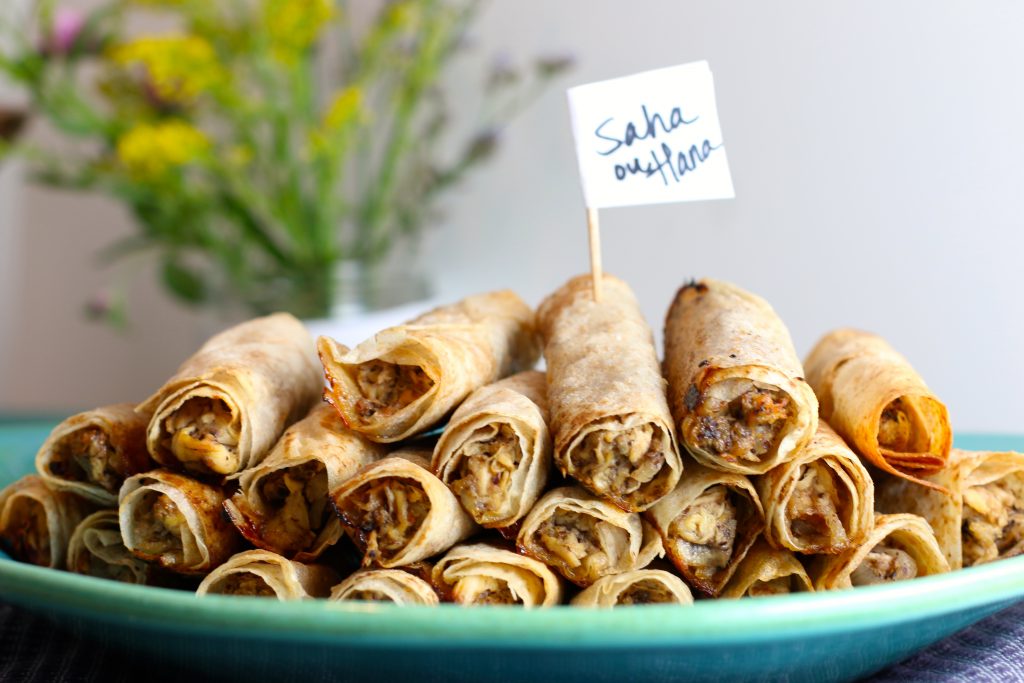
Chicken Rolls, A Modernized Msakhan (Chicken with Sumac and Onions) with Eid tag, “Saha ou Hana”, or “Bon Appetit” in Arabic.
The month of Ramadan may mean different things for different people, however at the end of the day, we can all agree that we are ready to feast! Growing up in a traditional Syrian household with an exceptionally great cook for a Mom, there was an endless array of mouth watering dishes every night for iftar. Now as I prepare the iftar for my family and friends, I try to emulate the delicious spread my Mom laid out when I was younger, but with my own innovative twists. Much in the same way, many children raised to immigrant parents try to uphold the traditions and values of their ancestors while also incorporating the positives of the society around them. The idea of a synergy between western and eastern cuisine brought to fruition in an easy accessible way was the inspiration behind my cooking style and ultimately the starting another branch of of my company, Sweet Pillar called Sweet Pillar Food. An Instagram page and blog to follow with inspirational Modern Middle Eastern cuisine.
Medijool Dates and Milk
While the taste of the food is of utmost importance, I am also a strong believer in a visually appealing food display and an aesthetic presentation. Incorporating “kitchen craft” to your iftar spread is a great and easy way to achieve a more personalized aesthetic. What I call kitchen crafts are the arts and crafts for food and includes food tags, menu print outs, name labels etc. The great thing about kitchen crafts is that they can be done ahead of time and there are a multitude of free printables online. They add such a special touch to any iftar and Eid dinner table but are unfortunately overlooked.
Hareesay
I also believe in experimenting with traditional recipes by tweaking some of the ingredients, usually to enhance different flavors or improve the nutritional content. This year, I played around with a traditional Arab dessert called Hareesay which is made using yogurtand semolina and yields a moist cake and topped with decedent honey syrup. With this recipe, I substituted flavored yogurt to add a slight fruit flavor. I also used greek yogurt to increase the protein content and decrease fat. After it was out of the oven, I printed out a mini lantern banner to place on top and I washed and cut stems from my garden flower bouquet to hang my lantern banner on. The result was a delicious dessert that evoked memories of my grandparents kitchen in Syria, with a fun modern twist that everyone loved.
As we approach the end of Ramadan and wonderful iftars, I challenge us all to think of using kitchen crafts this year for a more colorful and festive Eid! Follow my Instagram @sweetpillarfood for inspiration and tag you photos #sweetpillarfood to be featured! Inshallah a blessed Eid al Fitr to all of your family and friends.